Why a folding pruning saw still earns a place in the toolbox
The LZWCB-500 Aluminum-Handle Pole Saw sits in a category that never really goes out of use: manual cutting tools for branches, brush, and general outdoor trimming. For many buyers, the question is not whether a folding pruning saw can replace powered equipment entirely. It cannot. The real question is where a compact hand saw is the better choice, either because the job is smaller, the workspace is awkward, or the team simply needs a safer, quieter tool that is easy to carry.
That matters more than it may sound. Landscaping crews, orchard workers, maintenance teams, and even campsite users all run into the same practical issue: not every branch is worth firing up a powered saw, and not every site allows one. A folding saw gives you reach, control, and portability in a package that stores cleanly and is less likely to snag in transit. If the product is being evaluated as a procurement item, the decision is usually about fit: does the blade shape, handle design, and folding lock match the work pattern?
What the visible design tells a buyer
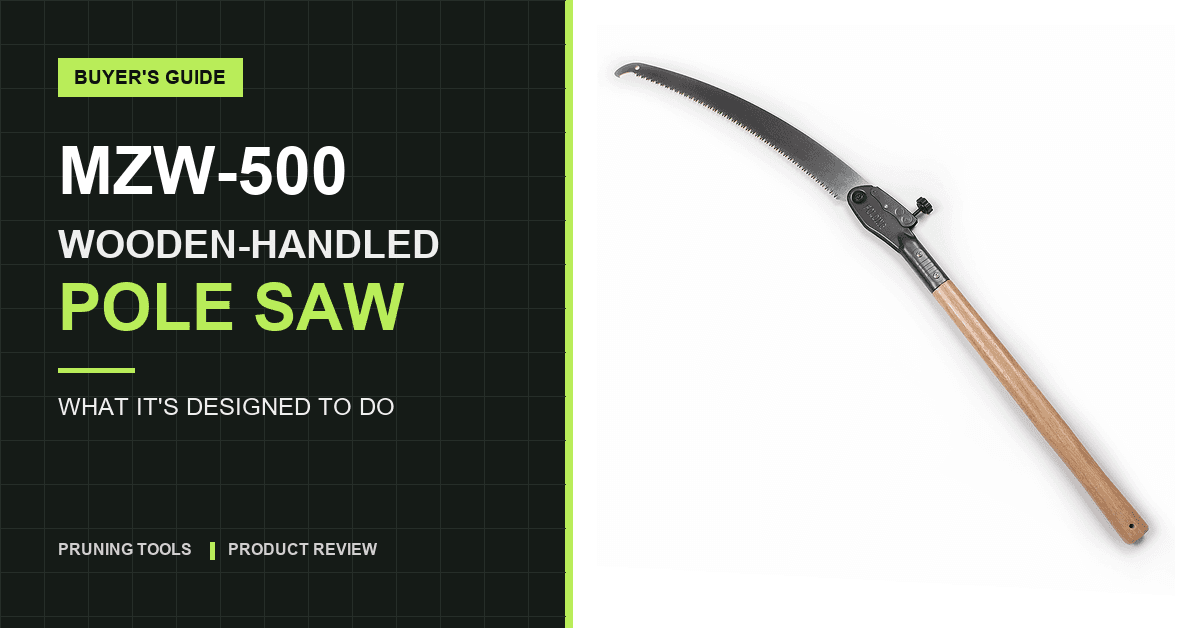
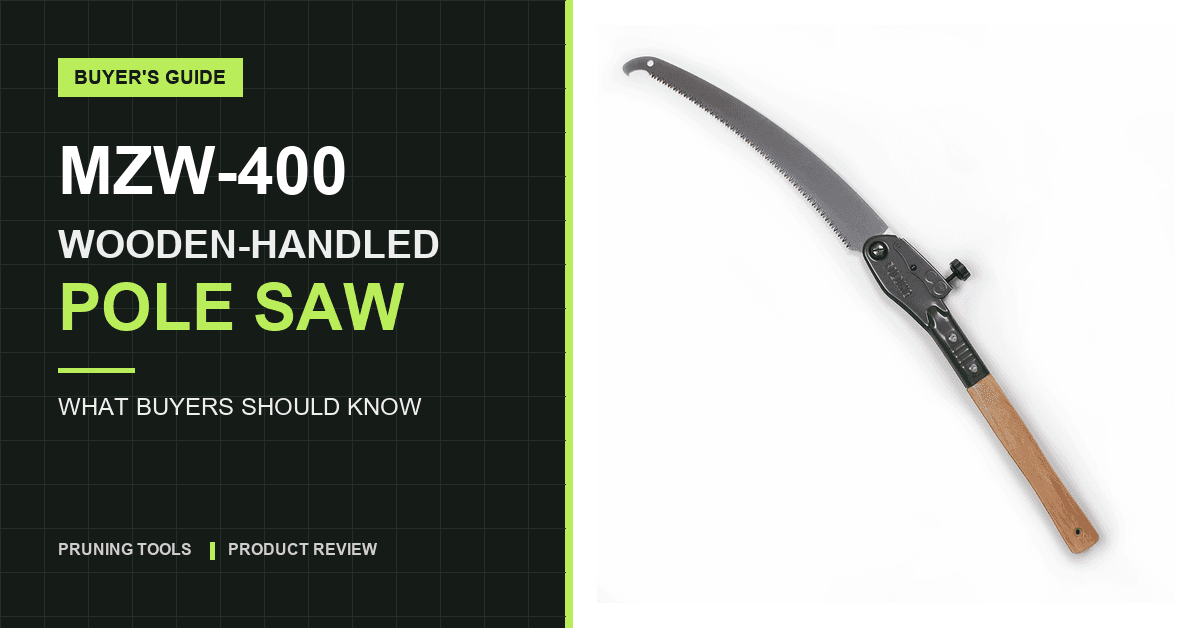
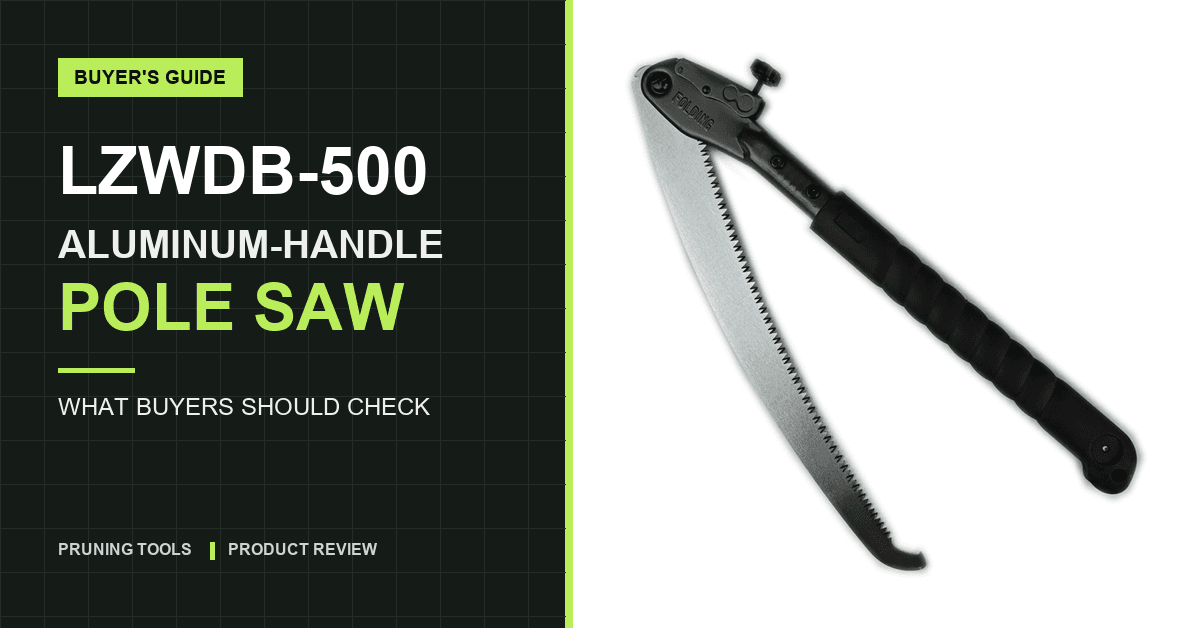
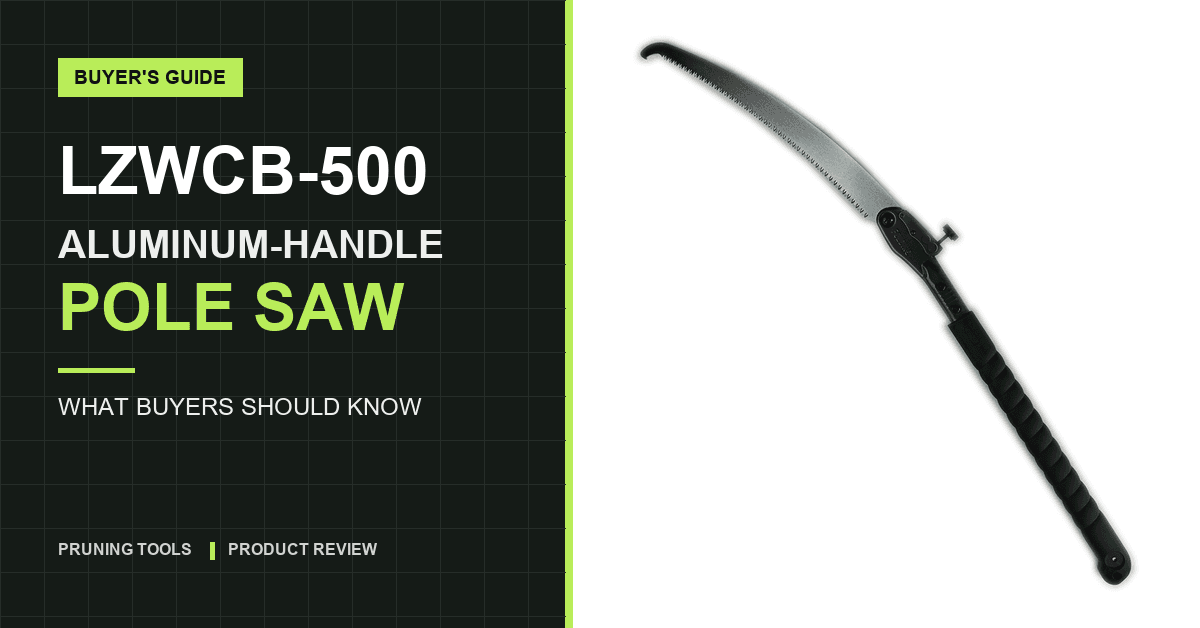
Based on the provided product information, the LZWCB-500 is a manual saw with a long curved metal blade, coarse teeth, and a black handle assembly with a textured grip. The blade appears to have a brushed or satin finish, and the pivot area near the head suggests a folding joint or locking mechanism. There is also a hanging hole at the end of the handle, which is a small detail but a useful one for storage and field carry.
The visible geometry points to pruning duty rather than fine carpentry. A curved blade with aggressive teeth is typically used to bite into green wood, small limbs, and woody material where a fast pull-cut matters more than a polished finish. The hooked or rounded tip can help steady the saw in a branch cut, though buyers should be careful not to assume every hook improves control in every task. In the wrong hands, a more aggressive tip can also catch where a smoother blade would glide.
Where a manual pruning saw makes sense
A saw like this is most relevant in garden pruning, orchard work, shrub trimming, and outdoor maintenance. It also fits camping and utility use, especially when portability and low noise are more important than speed. That is the real value proposition: not maximum cutting power, but predictable hand control.
For engineers and sourcing teams, that means the evaluation criteria are different from those used for a powered cutting tool. You are not only judging sharpness. You are also looking at:
Handle comfort during repeated strokes
Blade stiffness and resistance to flex
The behavior of the fold joint over time
Grip texture when hands are wet or dusty
Whether the tool is compact enough for kits, trucks, or belt carry
Those details are often more important than a flashy specification sheet, especially when the end user is working outdoors and carrying the saw all day.
Quick comparison: what buyers usually care about
Folding saw versus fixed-blade saw
A folding design usually offers better storage safety and easier transport. That is especially useful for crews sharing vehicles or moving between sites. A fixed-blade saw can sometimes feel more rigid, but it is less convenient in the field and requires more careful storage.
Curved blade versus straight blade
A curved blade often helps maintain cutting engagement on branches and can feel efficient in pruning work. Straight blades have their own advantages in some pulling motions, but for general outdoor trimming, a curved profile is common for good reason.
Coarse teeth versus finer teeth
Coarse teeth typically cut woody material faster and clear chips more readily. The tradeoff is that they are less suited to delicate work. If the task is branch removal and rough yard maintenance, coarse teeth are usually the sensible choice.
Likely manufacturing and assembly approach
The product data points to a fabricated metal blade and molded handle components, with an assembled folding-lock structure at the pivot. That is a standard approach for this class of tool. The blade may be stamped or cut from steel, then ground and sharpened along one edge. The handle appears to be molded plastic or a rubberized overmold, though the exact composition is not identifiable from the image.
That matters to buyers because manufacturing method affects consistency. A well-executed stamped and ground blade can be economical and durable enough for routine field use, provided the tooth geometry is clean and the finish resists corrosion reasonably well. Likewise, an injection-molded handle with a secure overmold can improve grip comfort, but only if the interface is tight and the surface does not become slick after a few weeks of use.
The lock mechanism deserves attention. Folding tools live or die by their pivot quality. If the lock is loose, overcomplicated, or awkward to release with gloves on, the saw becomes annoying in practice no matter how good the blade looks on paper. A buyer should always treat the pivot as a wear point, not an afterthought.
Selection criteria that matter more than marketing language
The product description does not provide blade length, tooth count, hardness, or a rated cutting capacity, so those should not be assumed. In a sourcing review, that missing data is a problem only if the buyer needs standardization across a fleet. For a one-off purchase, the practical test is simpler: does the saw feel balanced, does the lock hold securely, and do the teeth look aggressive enough for the intended wood size?
A few field-facing criteria are worth checking:
The grip should be long enough to support a full hand without crowding the pivot area.
The lanyard hole should be positioned so the saw hangs cleanly and does not flip open in storage.
The folding action should feel controlled, not gritty.
The blade should close without obvious interference from the handle shell.
The tooth profile should match the expected cut material; green wood and dry limbs do not behave the same way.
A small caution here: buyers sometimes focus on the blade and ignore the handle finish. That is a mistake. A saw that cuts well but shifts in the hand becomes tiring quickly, especially for repetitive pruning.
Common buyer mistakes
One mistake is over-specifying a hand saw as if it were a power tool. For this kind of product, exact performance claims often depend on wood species, user technique, and maintenance. Another common error is assuming that a folding mechanism automatically means safer use. It helps with storage, yes, but the user still needs a firm lock check before cutting.
It is also easy to ignore the intended duty cycle. If the work involves continuous cutting of larger limbs, a manual folding saw may be the wrong choice. If the use case is occasional branch removal, light orchard work, or a portable backup tool, it can be a very sensible fit.
What the LZWCB-500 appears suited for
From the visible design alone, the LZWCB-500 Aluminum-Handle Pole Saw appears suited for outdoor trimming tasks where a compact, manually operated saw is preferred. The combination of a curved serrated blade, ergonomic-looking grip, and folding head points toward practical use in gardening, landscaping, and general yard maintenance. If the product is in fact intended to be used with an extension pole, that would extend its reach, but that feature should be verified before purchase rather than inferred from the name alone.
For sourcing managers, the main takeaway is straightforward: this is a utilitarian tool, not a precision instrument. Its value will come from the quality of the blade edge, the reliability of the folding joint, and the comfort of the grip during repeated use.
FAQ buyers usually ask
Is this the right tool for small branches?
Likely yes, based on the coarse-tooth pruning design. The actual branch size it can handle depends on the blade length and user technique, which are not supplied here.
Is a folding saw better for storage?
Yes. The compact folded form is one of the clearest advantages, especially for field kits, vehicles, and shared storage spaces.
Can the blade material be assumed from the image?
No. It appears to be metal, likely steel, but the exact grade, coating, and heat treatment are not identifiable from the provided information.
Practical next step for buyers
If you are evaluating the LZWCB-500 for procurement or resale, ask for the missing technical details before committing: blade length, tooth specification, lock type, material composition, and any packing or transport dimensions. Those are the details that determine whether the saw fits a pruning kit, a landscaping bundle, or a general outdoor tool line.
For end users, the test is simpler. Check the lock, open and close the blade several times, and judge whether the grip feels secure with gloves. A folding pruning saw is a modest tool, but in the field, modest tools earn their keep by being dependable rather than impressive.